Car Battery Drains Overnight When Parked: Real Causes and Practical Fixes
Direct Answer Block
If your car battery drains overnight when parked, the most common causes are a parasitic electrical draw, a weak or aging battery, a faulty alternator diode, or a module that fails to go to sleep. Modern cars always use a small amount of power, but excessive drain means something is staying on when it shouldn’t.
Introduction
When a car battery drains overnight when parked, most drivers blame the battery and replace it. Sometimes that works. Often it doesn’t. The real issue is usually an electrical draw or charging problem that slowly pulls the battery down while the vehicle sits. Ignore it, and you end up stranded with a car that won’t start and a problem that keeps coming back.
Why does this problem happen?
In real cars, overnight drain usually comes down to four things.
1. Parasitic draw
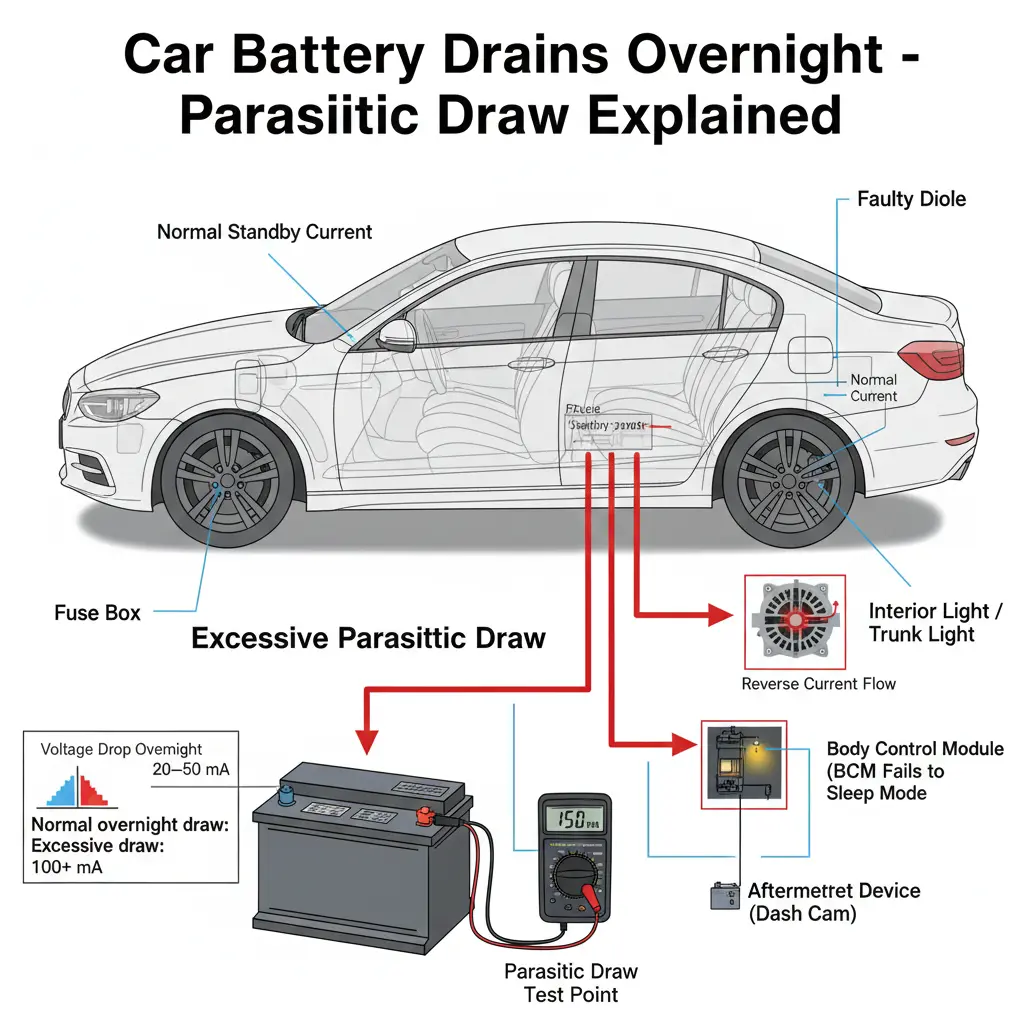
Every vehicle has a small parked car battery drain. The clock, alarm, ECU memory, and keyless entry system need power. That’s normal. What isn’t normal is when a control module, glove box light, trunk light, or infotainment unit fails to shut down. I’ve seen radios and body control modules stay awake all night and kill a battery in hours.
2. Weak battery
If the battery is more than 3–5 years old, it may not hold charge well. Even normal overnight draw can flatten it. Many people searching “how much car battery drain is normal overnight” don’t realize their battery is simply worn out.
3. Alternator diode failure
A failing alternator can cause a car battery drains overnight alternator issue. Bad diodes allow current to leak backward into the alternator when the engine is off. It won’t show obvious charging problems during driving, but it drains the battery while parked.
4. Aftermarket electronics
Dash cams, remote starters, poorly installed stereos. These are common reasons a car drains battery overnight.
What symptoms do drivers often ignore?
People dismiss early signs because the car still starts.
- Slightly slower crank in the morning
- Clock or radio presets resetting
- Battery warning light flickering briefly
- Needing a jump once every few weeks
These feel minor. But a battery that’s repeatedly drained loses lifespan fast. Every deep discharge damages it internally.
What early warning signs appear before serious failure?
Pay attention to subtle clues:
Sound: Engine cranks slower than usual.
Feel: Starter sounds strained, especially after sitting overnight.
Smell: Sulfur or rotten egg smell near the battery after charging attempts.
Performance change: Electrical glitches like flickering interior lights.
These show up before a complete no-start situation.
Is it safe to drive with this problem?
Short answer: Yes, if it starts reliably. No, if it’s draining repeatedly.
If the battery is only slightly weak and charging system works, you can drive short term.
It becomes risky when:
- You need frequent jump-starts
- The battery drains overnight or after days of no use
- Electrical systems behave unpredictably
Repeated draining can damage modules and shorten alternator life.
How can this problem be diagnosed safely?
Here’s what actually works.
Safe checks:
- Measure battery voltage after sitting overnight (should be around 12.6V fully charged)
- Inspect for interior or trunk lights staying on
- Disconnect aftermarket devices temporarily
- Check alternator output while running (around 13.7–14.5V)
An OBD scanner won’t directly measure draw, but it can show charging system faults or module errors.
What not to do:
- Don’t randomly pull fuses without understanding vehicle sleep cycles
- Don’t disconnect modern batteries without knowing reprogramming risks
- Don’t replace the battery repeatedly without testing draw
Proper parasitic draw testing requires a multimeter and patience. Many modern vehicles take 20–45 minutes to enter sleep mode.
For technical standards on battery testing, refer to organizations like the Society of Automotive Engineers and diagnostic guidelines published by the National Institute for Automotive Service Excellence.
What does this problem cost if ignored?
Caught early:
- Battery replacement
- Minor wiring repair
- Faulty relay replacement
Ignored:
- Alternator failure
- Control module damage
- Repeated tow bills
- Electrical system instability
Labor is often higher than parts. Electrical diagnosis takes time. Guessing gets expensive fast.
How can this problem be prevented long-term?
Real-world prevention:
- Drive the vehicle regularly if possible
- Replace batteries before they fully fail
- Avoid cheap aftermarket electronics
- Have charging system tested annually
- Clean battery terminals and ensure tight connections
If a vehicle sits for weeks, use a battery maintainer. That prevents parked car battery drain from turning into a dead battery.
For deeper understanding of electrical drain basics, resources from the Automotive Service Association are helpful.
When is professional help necessary?
Get a certified mechanic involved when:
- The car drains battery overnight repeatedly
- Voltage drops significantly within hours
- You suspect alternator diode failure
- Multiple electrical systems malfunction
Advanced diagnostics involve current draw testing with a clamp meter and isolating circuits one by one. This isn’t guesswork. Done wrong, it wastes time and money.
FAQ
Most vehicles draw between 20–50 milliamps once fully asleep. That small draw won’t kill a healthy battery overnight. If you’re seeing voltage drop below 12.4V by morning, something is wrong or the battery is weak.
Yes. A failed diode inside the alternator can allow reverse current flow when the engine is off. The alternator still charges normally while driving, which makes this issue harder to spot without proper testing.
If it dies overnight, suspect a heavy parasitic draw or failing battery. If it drains after several days, it may be a moderate draw combined with a weak battery. Testing both the battery and current draw is the only way to know for sure.