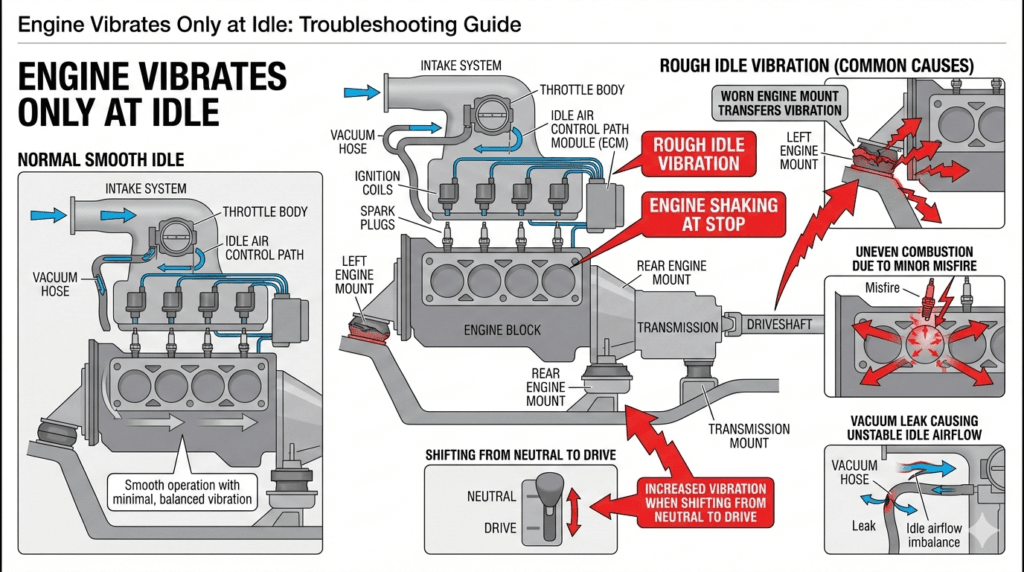
If your car shakes when idle, the most common causes are engine misfires, worn engine mounts, vacuum leaks, dirty throttle bodies, or fuel system problems. A slight vibration can be normal, but noticeable shaking while stopped usually means the engine is not running smoothly or the vibration is no longer being properly absorbed.
A car shakes when idle complaint is one of the most common issues drivers bring into a workshop. Many people ignore it because the vehicle still drives normally once it starts moving.
The problem is that rough idling often starts as a small issue and gradually becomes a bigger one. What feels like a harmless vibration today can eventually affect fuel economy, drivability, emissions, and even engine components if left unresolved.
Why does this problem happen?
When an engine is idling, it operates at its lowest RPM and produces very little momentum. Because of that, even small problems become noticeable.
Engine Misfires
A misfire is one of the most common causes I see in real-world diagnostics.
When a spark plug, ignition coil, or fuel injector fails to work properly, one cylinder contributes less power than the others. At higher speeds, the imbalance may be less noticeable. At idle, the entire vehicle can shake.
Worn Engine Mounts
Engine mounts are designed to isolate engine vibrations from the vehicle body.
As rubber mounts age, crack, or collapse, they lose their ability to absorb vibration. The engine may still run perfectly, but the cabin feels rough whenever the car is stopped.
Vacuum Leaks
Modern engines rely on carefully controlled airflow.
A cracked vacuum hose or leaking intake gasket allows unmetered air into the engine. This disrupts the air-fuel mixture and often creates an unstable idle.
Dirty Throttle Body
Carbon buildup around the throttle plate can restrict airflow.
The engine control system constantly tries to compensate, which may result in fluctuating RPM and vibration while idling.
Fuel Delivery Problems
Partially clogged injectors or low fuel pressure can cause uneven combustion. This often creates the feeling of a car vibrating when idling, especially when the engine is warm.
What symptoms do drivers often ignore?
Many drivers notice the signs but assume they’re normal.
Slight Steering Wheel Vibration
A steering wheel that vibrates while stopped at a traffic light is often dismissed. In reality, it can be an early sign of engine imbalance.
Shaking Only in Drive
Many automatic vehicles vibrate more when shifted into Drive with the brake applied. Drivers often assume that’s normal aging when it may indicate worn mounts.
Small RPM Fluctuations
A tachometer needle moving slightly up and down may signal an airflow or fuel control issue.
Reduced Fuel Economy
An engine that idles poorly often burns more fuel than necessary.
Ignoring these symptoms allows wear and carbon buildup to increase over time.
What early warning signs appear before serious failure?
Most rough idle issues provide warning signs long before major repairs become necessary.
Sound
You may hear uneven engine rhythm, occasional sputtering, or light popping sounds.
Feel
The seat, steering wheel, or dashboard may develop subtle vibrations that gradually worsen.
Smell
Unburned fuel odors can indicate incomplete combustion caused by misfires.
Performance Changes
The engine may hesitate during acceleration or feel less responsive than usual.
These signs often appear weeks or months before a check engine light activates.
Is it safe to drive with this problem?
Short answer: Sometimes, but it depends on the cause.
A mild vibration caused by aging engine mounts may not require immediate attention.
However, if the shaking is caused by an active misfire, vacuum leak, or fuel problem, continued driving can damage expensive components such as the catalytic converter.
Safe to drive temporarily:
- Mild vibration only at idle
- No warning lights
- No performance loss
Potentially unsafe:
- Flashing check engine light
- Strong shaking
- Fuel smell
- Loss of power
The stronger the vibration becomes, the sooner it should be diagnosed.
How can this problem be diagnosed safely?
Start with basic observations before replacing parts.
Check for Warning Lights
A check engine light provides valuable information about misfires and fuel system faults.
Use an OBD Scanner
A simple scanner can identify trouble codes such as:
- P0300 Random Misfire
- P0301–P0308 Cylinder Misfire Codes
These codes often point directly toward the affected cylinder.
Listen Carefully
Notice whether the idle becomes rough only when warm, only with the air conditioning on, or all the time.
Inspect Visible Components
Look for:
- Cracked vacuum hoses
- Loose intake tubing
- Obvious engine mount damage
What NOT to Do
Avoid replacing spark plugs, coils, injectors, and sensors randomly.
Parts swapping often costs more than proper diagnosis.
What does this problem cost if ignored?
The difference between early repair and delayed repair can be significant.
Low-Cost Repairs
- Vacuum hose replacement
- Throttle body cleaning
- Spark plug replacement
These are often relatively inexpensive.
Moderate Repairs
- Ignition coils
- Fuel injector service
- Engine mount replacement
Costs increase but remain manageable.
Expensive Repairs
Ignoring a misfire can damage:
- Catalytic converters
- Oxygen sensors
- Engine internals
A repair that could have cost a few hundred dollars can easily turn into thousands.
How can this problem be prevented long-term?
Most rough idle issues develop slowly.
Practical prevention includes:
- Replacing spark plugs on schedule
- Using quality fuel
- Cleaning the throttle body periodically
- Inspecting vacuum hoses during routine maintenance
- Fixing check engine lights promptly
- Addressing minor vibrations before they worsen
These habits significantly reduce the likelihood of future rough idle causes and fixes becoming expensive repairs.
When is professional help necessary?
Some situations require professional diagnosis immediately.
Seek professional help if:
- The check engine light is flashing
- The vehicle shakes severely
- The engine stalls at idle
- Fuel smells are present
- Misfire codes repeatedly return
Modern engines often require live data analysis, fuel pressure testing, and advanced diagnostic equipment that most owners do not have access to.
Continuing to drive under these conditions can cause permanent damage to emissions and engine components.
FAQ
The most common causes are engine misfires, worn engine mounts, vacuum leaks, or airflow issues. At idle, the engine produces less momentum, making even small problems easier to feel. If the vibration disappears while driving, the issue may still require attention. A proper diagnosis helps identify the exact source.
Yes. Worn spark plugs are among the most common rough idle causes. When a spark plug fails to ignite the air-fuel mixture properly, the affected cylinder contributes less power. This creates imbalance and vibration. Replacing worn plugs often restores smooth idle quality.
This usually happens because idle speed places the least load tolerance on the engine. Small issues like vacuum leaks, dirty throttle bodies, weak ignition components, or worn mounts become noticeable when the engine is sitting at low RPM. Once RPM increases during driving, the symptoms may become less obvious. That does not mean the problem has disappeared.
A car shakes when idle problem should never be dismissed as simply an old vehicle getting older. In many cases, the root cause is something relatively simple, such as worn spark plugs, a vacuum leak, or aging engine mounts.
The key is paying attention to the early signs. Small vibrations often provide an opportunity to fix the problem before it affects drivability, fuel economy, or major engine components. Diagnose it early, address the actual cause, and your engine will usually return to the smooth, stable idle it was designed to have.