Why Is My Engine Misfiring At Idle: Causes, Symptoms, and Real-World Fixes
Your engine misfires at idle because the combustion process is interrupted when the engine is under the least amount of load. This is typically caused by a vacuum leak, fouled spark plugs, a failing ignition coil, or a lean fuel mixture that becomes more apparent at low RPMs.
Why is my engine misfiring at idle?
If you’re sitting at a red light and feel your car rhythmic shaking, or if the needle on your tachometer is bouncing like a nervous habit, you’ve got a misfire. Most drivers ignore it because the car seems “fine” once they get moving. That’s a mistake. Understanding why is my engine misfiring at idle is the difference between a $50 spark plug swap today and a $2,000 catalytic converter replacement next month.
Ignoring a rough idle is like ignoring a persistent cough—it might just be allergies, but it’s often the first sign of a system starting to fail. If you handle it incorrectly by just throwing parts at the dashboard, you’ll waste money and likely leave the root cause untouched, leading to a stalled engine in heavy traffic.
Why does this problem happen?
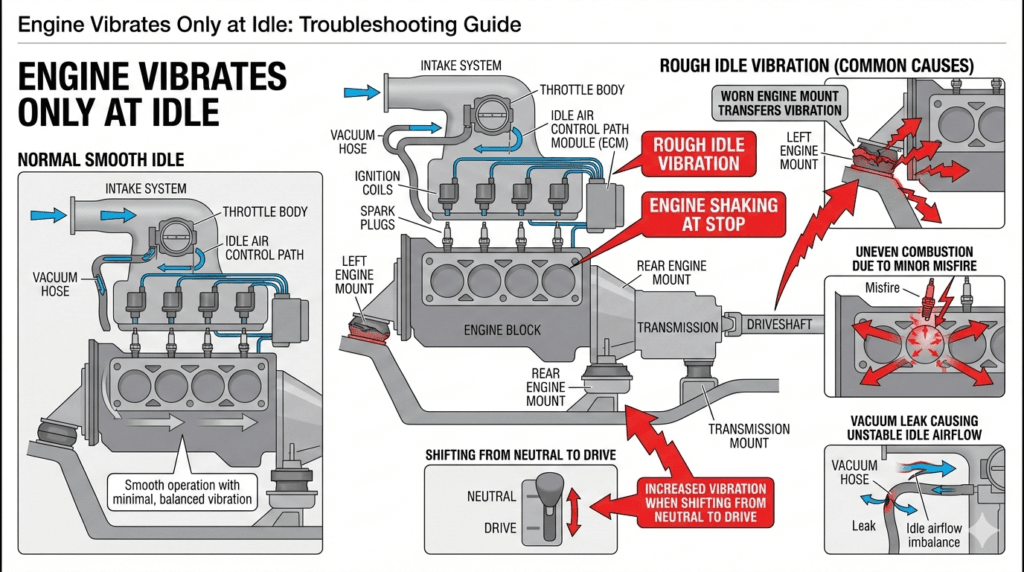
First is the Vacuum Leak. At idle, your throttle plate is nearly closed. The engine is sucking in a very small, precise amount of air. If there is a tiny crack in a rubber hose or a leaking intake manifold gasket, “unmetered” air sneaks in. This leans out the mixture. Once you step on the gas, the throttle opens, a massive amount of air enters, and that tiny leak becomes insignificant. That’s why the misfire “disappears” at highway speeds.
Second is Ignition Breakdown. Spark plugs and coils have to work harder at idle to keep a stable flame front in the cylinder. If a coil is weak, it might struggle to fire consistently when the alternator is spinning slowly and the engine is at its lowest thermal efficiency.
Third is Carbon Build-up. On modern Direct Injection (GDI) engines, carbon blocks the intake valves. At high speeds, the air velocity is high enough to tumble past the gunk. At idle, the airflow is lazy; the carbon creates turbulence that disrupts the air-fuel mix, causing a stumble.
What symptoms do drivers often ignore?
Most people dismiss a “shudder” at a stoplight. They think, “Well, it’s an old car,” or “It’s just cold.”
- The “Hiccup”: You’re sitting in Drive with your foot on the brake, and the car feels like it’s trying to jump forward for a split second.
- The Interior Rattle: Your rearview mirror vibrates or the coins in your cupholder jingle only when you’re stopped.
- Slight RPM Fluctuations: Watching the needle dip from 800 to 600 RPM and then recover.
Ignoring these is dangerous because a misfire means unburned fuel is leaving the cylinder. That raw gas travels down the exhaust and hits your catalytic converter, which operates at 900°F to 1600°F. The gas ignites inside the converter, melting the precious metals inside and turning a minor tune-up into a massive repair bill.
What early warning signs appear before serious failure?
Before the Check Engine light starts flashing (which indicates a catalyst-damaging misfire), your car will talk to you.
- The Smell of Rotten Eggs: This is the scent of sulfur. It means your catalytic converter is already struggling to process the raw fuel from a misfiring cylinder.
- Hard Starts: If your engine keeps misfiring, it might take an extra second or two to crank in the morning.
- The “Stumble” on Takeoff: When you let off the brake to accelerate, there’s a momentary hesitation before the power kicks in. This is a classic sign that the air-fuel ratio is off.
Is it safe to drive with this problem?
No, it is not advisable to continue driving long-term with a misfire. While the car may feel “drivable,” you are actively damaging the engine’s emission system and increasing internal wear.
- Short Term: You can likely drive it to a local repair shop or home. Avoid heavy acceleration.
- When it’s Dangerous: If the Check Engine light begins to flash, pull over immediately. A flashing light means the misfire is so severe that it is currently melting your catalytic converter.
- The Logic: If the car feels like it’s going to stall at every light, you risk losing power steering and power brakes in the middle of an intersection. That is a safety hard-stop.
How can this problem be diagnosed safely?
You don’t need a degree in mechanical engineering to do basic triage.
The Visual Check: With the engine off, pop the hood. Look for cracked, hissing, or disconnected rubber hoses. A $10 can of soapy water sprayed near the intake manifold while the engine is running can reveal a vacuum leak (look for bubbles or a change in engine sound).
The OBD2 Scanner: This is your best friend. A cheap Bluetooth scanner can tell you exactly which cylinder is the culprit (e.g., Code P0301 is Cylinder 1). Once you know the cylinder, you can swap the ignition coil to the next cylinder. If the misfire moves with the coil, you’ve found your broken part.
What NOT to do: Do not pull spark plug wires while the engine is running. Modern ignition systems carry enough voltage to give you a dangerous shock, and you can easily fry the car’s computer (ECU).
What does this problem cost if ignored?
In my experience, the “cost of waiting” is about 10x the cost of the original fix.
| Component | Early Fix Cost | Delayed Repair Cost |
| Spark Plugs | $50 – $150 | $1,500+ (if it kills the Cat) |
| Vacuum Leak | $10 (New Hose) | $400+ (O2 Sensor/Towing) |
| Ignition Coil | $100 – $200 | $2,500+ (ECU damage) |
Labor usually accounts for about 60% of these costs. Diagnostic time is where most people lose money; being able to tell a mechanic “it only happens at idle” saves them an hour of hunting and saves you $150.
How can this problem be prevented long-term?
What causes misfire at idle most often is neglected maintenance.
- Stick to the Schedule: If your manual says change plugs at 60k miles, don’t wait for 100k.
- Top-Tier Fuel: Use gasoline with detergent additives to prevent injector clogging and carbon buildup.
- Clean the Throttle Body: Every 30k miles, cleaning the throttle plate can prevent the idle air controller from getting “sticky,” which often mimics a misfire.
When is professional help necessary?
If you’ve checked for vacuum leaks and swapped your coils, but the engine keeps misfiring, it’s time for a pro.
DIY ends when you get into Fuel Delivery or Compression. Testing fuel pressure involves tapping into high-pressure lines—get it wrong, and you have a fire. Similarly, a “dead” cylinder caused by a burnt valve or a blown head gasket requires a compression test and heavy engine teardown. If your coolant looks like a milkshake or your oil smells like gas, stop what you’re doing and call a flatbed.
FAQ
This usually points to a vacuum leak or a “lean” condition. At higher speeds, the engine pulls in so much air that a small leak becomes a tiny percentage of the total intake. At idle, that same leak is a huge percentage of the air, causing the mix to be too thin to burn properly.
Rarely. A dirty air filter usually restricts air at high speeds/loads, causing the engine to bog down when you accelerate. If you’re experiencing a rough idle, look toward spark, fuel injectors, or vacuum lines before blaming the air filter.
No, mechanical and electrical components do not “heal.” While a bad batch of gas might cause a temporary stumble, a true misfire is a sign of a failing component. Ignoring it will only lead to more expensive repairs, like a clogged catalytic converter or fouled oxygen sensors.
Conclusion
A misfire at idle is your car’s way of asking for a check-up before things get expensive. Start with the basics: check your vacuum lines, scan for codes, and look at your spark plugs. Most of the time, what causes a misfire only at idle is a simple fix that you can handle in an afternoon. Stay calm, don’t ignore the shudders, and keep that catalytic converter healthy by addressing the stumble today.